ServicesUnder-sink reverse osmosis
Under-Sink Reverse Osmosis in Hurst
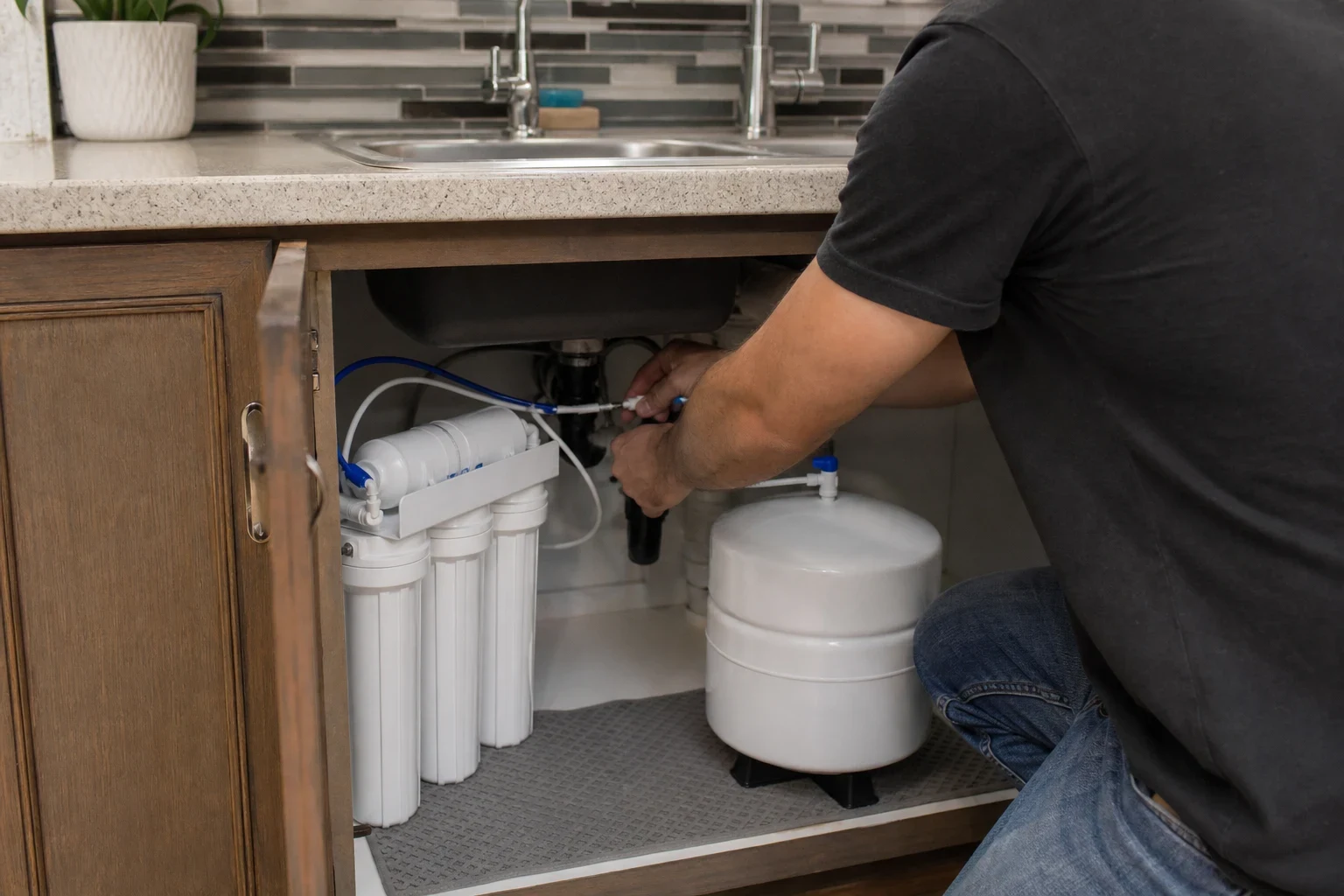
We fit a reverse osmosis unit in the cabinet below your kitchen sink, with its own small faucet for drinking and cooking. Drop cloths go down first, your things go back where they were, and we show you every filter before we pack up.
What an Under-Sink RO System Does
Reverse osmosis pushes water through a very fine membrane. Most dissolved minerals, lead, and many trace contaminants stay behind and get flushed down the drain. What comes out is stored in a small tank and sent to its own faucet at your sink.
It is a drinking water system, not a whole-house one. It handles the water you put in a glass, a coffee pot or a stock pot. If your main complaint is chlorine smell in the shower, whole-house carbon filtration is the better fit, and we will tell you that.
Plenty of Hurst homes still have older faucets and fittings under the sink. RO is a sensible way to take the guesswork out of what those parts might add to your drinking water.
What the Install Includes
- Prefilters and the membrane
- Grit is caught by a sediment filter, and a carbon filter removes chlorine so it doesn't wear out the membrane. The membrane then handles the fine filtering.
- Tank and final filter
- A compact pressure tank stores filtered water for an even flow. A last carbon filter cleans up the taste before water reaches the faucet.
- A faucet just for RO water
- Where possible, we use the sprayer or soap dispenser hole you already have. If a new hole is needed, we check with you first about your countertop and the spot.
- Supply valve and drain hookup
- A new valve taps the cold line, and the reject line connects to the sink drain with a proper saddle. Both get a leak check before we finish.
- Fridge or ice maker line, if you want it
- We can run filtered water to your refrigerator, routing the line so it's hidden and off the floor.
- Walkthrough and clean cabinet
- You see where every filter is, how to turn the system off and when parts are due. We then wipe the cabinet clean and gather up the drop cloths.
Signs an RO System Makes Sense
You buy cases of bottled water
If the tap only gets used for dishes, RO can give you water you actually want to drink. It also means fewer jugs to haul home.
Coffee and tea taste off
Chlorine and dissolved minerals change flavor. Filtered water usually makes a cleaner cup.
Older plumbing under the sink
Old faucets, solder and fittings can add lead to standing water. RO membranes are good at taking it out.
Cloudy ice and kettle scale
White crust in the kettle and cloudy ice cubes point to dissolved minerals. An RO line to the fridge helps with both.
A test came back with questions
If water testing turned up something you want reduced at the drinking tap, we can tell you plainly whether RO handles it.
What Moves the Price
The system itself is only part of it. The rest depends on your kitchen and what you want the water to do. We price it after we see the sink, and the estimate shows each piece.
System type
Tank systems and tankless units cost differently. Extra stages, like a remineralizing filter, add to it.
Faucet hole and countertop
Using an existing hole is simple. Drilling granite or quartz takes more time and the right bits.
Extra water lines
Running a line to the fridge or ice maker adds tubing, fittings and labor, more so if the route is long.
Shutoff valves and pressure
Old, stuck valves sometimes need replacing first. Low household pressure can call for a small booster pump.
How the Job Goes
- 1
Phone call and visit
You tell us what bothers you about your water. We come out, open the cabinet and check space, the disposal, the shutoff valves and your water pressure.
- 2
Written estimate
You get a line-item estimate with the system, faucet and any extras listed. If a different service fits better, we say so.
- 3
Install day
We put down drop cloths and a mat in front of the sink. With your OK we move your cabinet items to a spot you choose, shut off the cold water and do the install. Most kitchens are done in a few hours.
- 4
Flush, check, explain
We flush the new filters and the tank, then check every fitting for drips. You get a short walkthrough and a note of when the filters are due. Your things go back under the sink.
Under-Sink RO Questions
Does reverse osmosis waste water?
Yes, some. The membrane rinses itself by sending part of the water to the drain. Newer systems send less than older ones, and we can walk you through the options on the call.
How often do the filters need changing?
Prefilters usually go every six to twelve months, depending on use. The membrane lasts longer, often a couple of years. We can handle it through our filter replacement and maintenance service, or show you how to do it yourself.
Will it fit under my sink with a garbage disposal?
Usually. The tank is the bulky part, and we place it where it leaves room for the disposal and some storage. If space is truly tight, a tankless unit is an option.
Will the water taste flat?
Some people notice RO water tastes very plain because the minerals are gone. A remineralizing post filter adds a little back. You can try it either way.
Should I test my water first?
It helps. Water testing tells you what is in your tap water, so you know RO is the right tool. We will not push a system if the results do not call for one.
Let Us Take a Look Under Your Sink
We will look at your sink, answer your questions and give you a clear written estimate. Your floors and cabinet stay clean while we work.